

João Mota
CTO | CMO
Monitoring, maintenance and planning.
In a business world increasingly dependent on technology, the stability of IT infrastructure is no longer just a technical concern; it has become a critical factor for the continuity, security and productivity of organisations. Even so, many companies continue to look at IT infrastructure only when something fails.
The truth is simple: stable infrastructure doesn't happen by chance. Just like a secure and functional home, it requires constant monitoring, regular maintenance and careful planning.
IT Infrastructure as a House
Imagine a company's technological infrastructure as a house.
A well-constructed house can be comfortable, efficient and safe. However, even the best construction degrades without care. Small ignored problems turn into serious failures. A poorly closed door compromises security. A neglected leak generates structural damage.
The same applies to computer systems.
Servers, networks, backups, applications and devices form the organisation's digital structure. Without supervision and maintenance, any component can become a point of failure.
Monitoring: Watch before it fails
Monitoring is equivalent to having sensors in a house: alarms, cameras, smoke detectors.
It allows continuous monitoring of the infrastructure state:
- Server performance
- Resource utilisation
- Network status
- Intrusion attempts
- Abnormal behaviour
Without monitoring, problems are only detected once the impact is already apparent: slow systems, unavailable applications, unexpected outages.
With proactive monitoring, the company can:
- Identify faults before they cause outages
- Anticipate performance limitations
- Reduce downtime
- Improve the user experience
More than just a technical tool, monitoring is a prevention mechanism.
Maintenance Preserving what works
No house stays in good condition without maintenance. Painting, electrical checks, replacing worn components, everything contributes to preventing bigger problems.
In IT infrastructure, maintenance includes:
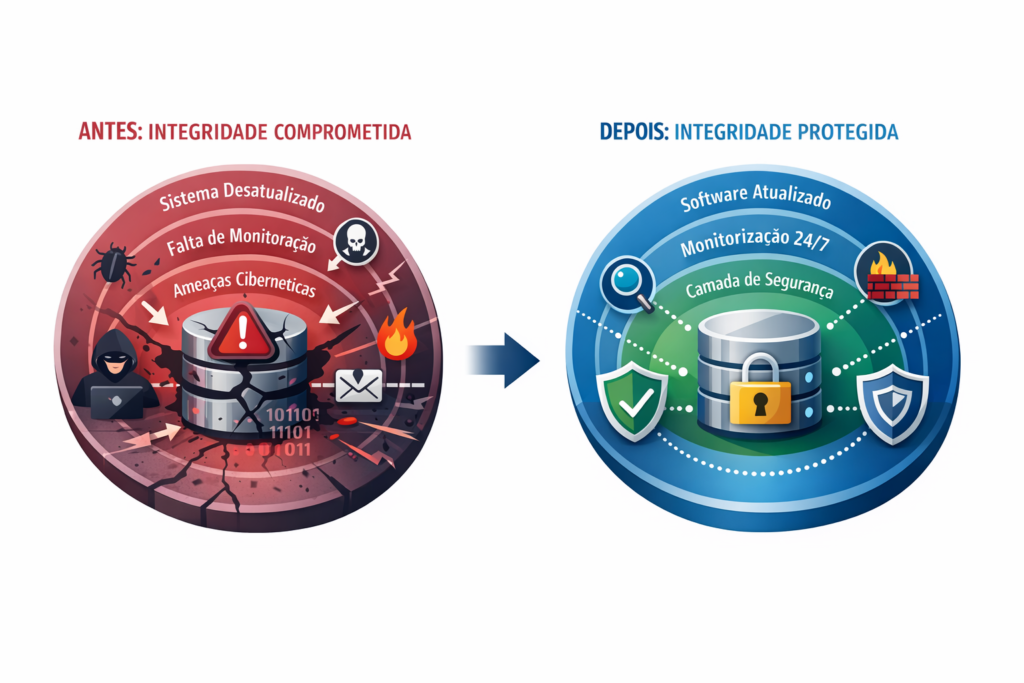
- Software and security updates
- Vulnerability fixes
- Backup verification
- System optimisation
- Performance tests
Ignoring these tasks is akin to leaving windows unlocked or facilities degraded.
Consistent maintenance allows:
- Increase the lifespan of the equipment
- Reduce the risk of unexpected failures
- Minimise security vulnerabilities
- Ensure proper performance
It is important to understand that many tech incidents do not result from sophisticated attacks, but from outdated or poorly maintained systems.
Planning: Preparing the Future
A well-thought-out house does not just respond to current needs, it anticipates the future. Additional space, structural reinforcement, energy efficiency.
Strategic planning of IT infrastructure follows the same logic.
It involves decisions such as:
- System scalability
- Capacity growth
- Adoption of new technologies
- Business continuity
- Disaster recovery
Without planning, companies frequently end up in scenarios such as:
- Infrastructure with reduced capacity
- Reactive and costly investments
- Technological incompatibilities
- High operational risks
With proper planning, it is possible:
- Aligning technology with business objectives
- Optimise investments
- Ensure flexibility and sustainable growth
- Reduce risks and disruptions
Stability is not just performance, it is security
A stable infrastructure is not just fast or efficient. It is also secure.
Just like a house with well-protected doors and windows, business systems need:
- Access control
- Threat protection
- Security event monitoring
- Update policies
The absence of these elements turns the infrastructure into a vulnerable target.
The Proactive Approach: The real differentiator
Technologically mature companies share a common characteristic: they adopt a preventative approach.
They don't wait for failures. They don't just react to incidents. They invest in:
- Continuous monitoring
- Systematic maintenance
- Strategic planning
This stance translates into clear benefits:
- Greater system availability
- Unexpected cost reduction
- Increase in productivity
- Minimisation of operational risks
- Security reinforcement
Stable infrastructure, resilient business
In a context where technology supports practically all business operations, the stability of the IT infrastructure directly impacts:
- Business continuity
- Operational efficiency
- Information security
- Customer trust
Just as a solid house offers comfort and protection, a well-managed infrastructure offers predictability and security.
Concluding Remarks
Technological stability does not depend exclusively on the quality of equipment or software. It results, above all, from the way infrastructure is monitored over time.
Monitoring, maintaining and planning are not optional tasks; they are fundamental pillars of any organisation that aims to grow securely and with confidence.
Because, in the end, prevention will always be more efficient and less costly than a cure.
To find out more about the topic, you can book a meeting with João Mota, CTO of Quantinfor, and get all your questions answered: https://calendly.com/joaomotaquantinfor/30min